
Can Photos and Video Clarify Denver Parking Lot Liability?
Parking-lot collisions often happen at low speeds, but determining responsibility can still be complicated. A driver may be backing out of a space, traveling through an aisle, turning across a row, or trying to see around a large vehicle. If you are asking, “Who Is Responsible for a Collision in a Denver Parking Lot?” the answer may depend on much more than which vehicle was moving last.
Denver parking lot accident liability can involve right-of-way, driver awareness, visibility, lane markings, signs, and the design or maintenance of the property. Evidence may disappear quickly when surveillance systems overwrite footage or vehicles are moved before photographs are taken. Neumann helps Colorado readers understand the issues that may matter in a private-property crash without assuming that every collision has a simple answer.
This article explains how fault may be evaluated, what to photograph and request after a crash, how shared fault can affect a claim, and when legal guidance may be useful. The same general evidence principles may apply in Aspen, although the facts and governing law can vary by location.
How Is Denver Parking Lot Accident Liability Determined?
Parking lots may be privately owned, but drivers still generally have a responsibility to operate with reasonable care. The analysis usually begins with the movements of each vehicle and the surrounding conditions. A driver backing from a space may need to yield to vehicles already traveling through an aisle, while an approaching driver may still have a duty to watch for vehicles emerging from parking spaces and adjust speed when visibility is limited.
There is no universal rule that the driver who was moving last is automatically responsible. Investigators, insurers, and attorneys may examine whether either driver failed to look, failed to yield, traveled too quickly for the conditions, or made a turn without adequate clearance. Directional arrows, stop signs, one-way markings, speed bumps, and aisle design may provide important context.
Backing, visibility, and right-of-way
Backing crashes often raise questions about whether the reversing driver could see the aisle and whether the other vehicle had a reasonable opportunity to avoid the collision. A driver moving forward is not automatically free from responsibility if the vehicle was speeding, distracted, or positioned where it could not be seen. Colorado claims may also involve comparative-fault questions, meaning more than one person’s conduct can be considered.
When property design matters
Poor lighting, blocked sight lines, confusing traffic patterns, faded markings, or an obstructed mirror may be relevant to a private property car accident claim. These conditions do not automatically establish that a property owner or manager is legally responsible. Their importance depends on what existed, who controlled the area, whether the condition was known or reasonably discoverable, and whether it contributed to the collision.
What Should You Photograph and Request After a Parking-Lot Crash?
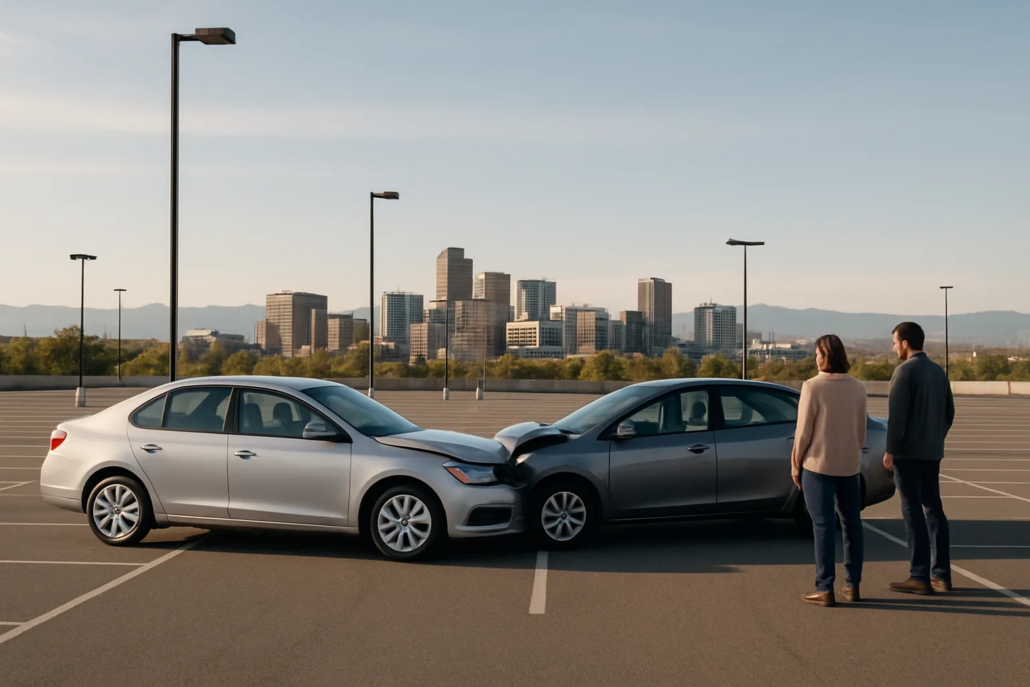
A careful record can help preserve the circumstances before vehicles are moved or conditions change. If it is safe to do so, photographs and information requests should show the entire setting, not just the visible damage.
- The final position of each vehicle, including the direction each vehicle was facing.
- Damage from several angles, along with debris, skid marks, tire marks, or fluid on the pavement.
- A wide view of the aisle, parking spaces, intersections, entrances, exits, and nearby structures.
- Stop signs, arrows, lane markings, curbs, wheel stops, mirrors, speed bumps, and any obstructed or missing signs.
- Lighting conditions, shadows, weather, surface conditions, and objects blocking a driver’s view.
- Nearby businesses, cameras, gate systems, parking kiosks, or security equipment that may have recorded the event.
Ask witnesses for their names and contact information, and make a brief note of what each person says while the memory is fresh. Avoid pressuring anyone to adopt a particular version of events. A neutral witness may be able to describe vehicle positions, signals, speed, or whether a driver sounded a horn.
You can also ask the property owner, store manager, parking operator, or security desk to preserve any parking lot surveillance footage accident evidence. Request the appropriate property-management contact information and note when and how you made the request. Do not assume that a verbal request will preserve footage indefinitely; retention periods and access policies vary.
In Denver, an incident report or insurance exchange may provide useful baseline information, but a report is not necessarily a final determination of civil liability. Similar steps may be useful after a collision in Aspen, subject to the circumstances and local procedures.
How Can Shared Fault and Evidence Affect a Colorado Parking-Lot Claim?
Low-speed impacts can produce conflicting accounts. One driver may say the other vehicle suddenly backed into the aisle; the other may say the moving vehicle had time to stop. Insurers may compare statements, photographs, damage patterns, witness accounts, video, and the physical layout before deciding how they view the claim.
Colorado’s rules concerning negligence and comparative fault may be relevant to an injury or property-damage case, but the legal effect depends on the facts and the type of damages claimed. Laws and procedures can change, and private-property disputes may involve issues different from those in a public-road crash. A licensed Colorado attorney can evaluate the applicable law rather than relying only on an informal parking-lot rule.
Common mistakes include:
- Moving vehicles before photographing their positions when there is no safety reason to do so.
- Photographing only the dent while failing to capture signs, lighting, sight lines, or aisle layout.
- Assuming a store, landlord, or parking operator is automatically liable because the crash occurred on its property.
- Waiting too long to identify cameras or request preservation of footage.
- Giving a broad recorded statement before reviewing the available facts.
- Treating a police or security report as conclusive instead of checking it for factual errors or omissions.
Medical concerns should also be documented through appropriate professional care, without assuming that the absence of immediate symptoms resolves the legal or factual questions. If an injury claim, disputed responsibility, or significant property damage is involved, a lawyer may help organize the evidence and assess possible sources of recovery.
Frequently Asked Questions
Does a parking lot crash have the same rules as a street collision?
Not necessarily. Colorado traffic principles may inform the analysis, but a private parking lot can have its own signs, aisle markings, access controls, and design features. Responsibility may depend on the conduct of each driver and the condition of the property. The applicable legal analysis can vary between Denver, Aspen, and other Colorado locations, so general parking-lot customs do not replace a fact-specific review.
Can a property owner be responsible for a Denver parking-lot collision?
Possibly, but a crash on private property does not automatically make the owner or manager liable. Evidence may need to show a property condition, such as inadequate lighting or an obstructed sight line, that was connected to the collision and involved a legally recognized duty. The owner’s control, notice, maintenance practices, and the drivers’ own conduct may all matter.
How can I obtain parking-lot surveillance footage?
Start by identifying who controls the cameras, such as a store, landlord, security company, or parking operator. Make a prompt written preservation request that identifies the date, approximate time, location, and vehicles involved. Access may depend on company policy, privacy considerations, insurance processes, or formal legal procedures. An attorney can discuss options when footage is important and voluntary disclosure is not available.
What if both drivers may have contributed to the crash?
A claim is not necessarily defeated because responsibility may be shared. Colorado’s comparative-fault framework can affect whether and how damages are pursued, but the result depends on the evidence and the type of claim. Photos, video, witnesses, statements, and damage patterns may help clarify each person’s role. A Colorado attorney can explain how those facts may affect a particular case.
How Neumann Can Help
Neumann is dedicated to helping people understand the evidence and legal issues that can arise after Denver parking lot collisions. The firm can review vehicle positions, photographs, signage, surveillance questions, witness information, lighting, and property-management details as part of a broader evaluation. Neumann is committed to fighting for clients’ rights while recognizing that every collision has different facts and that no result is guaranteed.
If you were involved in a parking-lot crash in Denver, Aspen, or elsewhere in Colorado, contact Neumann for a free consultation or case evaluation. The firm is ready to evaluate your situation and discuss your legal options.
The information in this article is for educational purposes only and does not constitute legal advice. Contact a qualified attorney licensed in Denver; Aspen for advice specific to your situation.


Leave a Reply
Want to join the discussion?Feel free to contribute!