
How Does a Hit-and-Run Attorney Build a Denver Crash Claim?
A collision can leave you with damage, injuries, and unanswered questions—especially when the other driver leaves before exchanging information. How do you pursue a Denver hit-and-run car accident claim without knowing who caused the crash? In many cases, the answer begins with prompt reporting, careful documentation, and an insurance review rather than speculation about the missing driver.
The evidence may include paint transfer, broken vehicle parts, debris, nearby video, witness accounts, license-plate fragments, and police records. Your own auto policy may also contain uninsured motorist coverage that could apply, depending on the policy and the facts of the collision. Neumann helps Colorado accident victims understand how these pieces may fit together. This guide explains what to do at the scene, how to preserve evidence, how insurers may evaluate a hit-and-run, and when legal guidance may be useful.
How Can Denver Hit-and-Run Victims Preserve Evidence?
The first goal is to create a reliable record before evidence disappears. If anyone may be seriously injured or the roadway presents an immediate danger, contacting emergency services is important. Otherwise, reporting the collision to the appropriate law enforcement agency can create an official record and may help investigators connect separate reports involving the same vehicle.
Report the collision and document the scene
When speaking with police, describe what you observed without guessing about the driver’s identity, speed, intent, or legal responsibility. Useful details may include:
- The location, direction of travel, lane position, and approximate time
- Vehicle color, body style, make, model, distinctive damage, or missing parts
- Any portion of a license plate, even if incomplete
- The direction in which the vehicle left
- Names and contact information for witnesses, when available
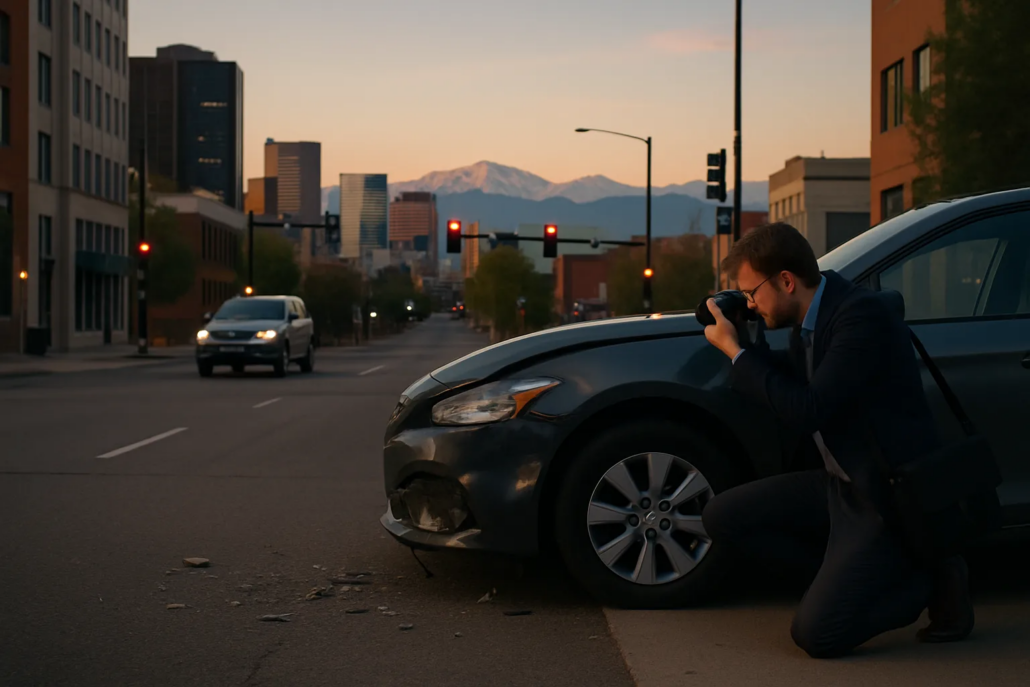
Photograph your vehicle from multiple angles before repairs or cleaning. Close-up images of paint transfer, dents, broken lamps, tire marks, glass, and embedded debris may help show how contact occurred. Wider photos can preserve traffic signals, lane markings, lighting, weather, road conditions, and nearby businesses or residences.
In Denver, conditions can change quickly as vehicles are moved, debris is cleared, or businesses overwrite camera footage. Keep damaged parts and other physical evidence when practical, and ask a repair facility to preserve removed components. Do not alter, repaint, or discard evidence before its significance has been considered.
What Denver Hit-and-Run Evidence Can Identify the Vehicle?
A successful investigation does not always require a complete license plate. Small details can become more useful when combined. For example, a fragment of a plate, a unique paint color, a broken mirror housing, and footage showing the vehicle’s route may help narrow the search. None of these items alone necessarily proves who was driving or who is legally responsible, so they should be treated as leads rather than conclusions.
Look for cameras and independent witnesses
As soon as reasonably possible, identify businesses, residences, parking facilities, traffic intersections, and transit areas that may have captured the collision or the vehicle leaving. Video may be held by a private owner, a property manager, a transportation agency, or another organization. A recording may be overwritten on a schedule that varies by system.
Potential sources of evidence include:
- Nearby security cameras facing the street, parking lot, or entrance
- Dashboard-camera footage from motorists who stopped or traveled nearby
- Witness accounts describing the vehicle, impact, or direction of travel
- Police photographs, dispatch information, and the completed crash report
- Repair estimates and inspection photographs documenting the damage pattern
Denver Police Department may handle reports within the city, while another agency may have jurisdiction depending on where the collision occurred. On a state highway or outside Denver city limits, Colorado State Patrol or a local law enforcement agency may be involved. Jurisdiction and reporting procedures vary by location, so records should be requested from the agency that investigated the crash.
Notify insurers without guessing
Promptly notifying your insurer can protect your ability to explore coverage, but an initial report does not require you to identify an unknown driver. You can provide the known facts, explain that the vehicle left, and share the police report number and available evidence. Avoid agreeing to a recorded statement or settlement before understanding the policy provisions and the extent of your injuries and property damage; depending on the circumstances, an attorney may help you evaluate those communications.
How Does Uninsured Motorist Coverage Affect a Hit-and-Run Claim?
In Colorado, a hit-and-run driver who cannot be identified or located may be treated as an uninsured motorist for insurance purposes, but coverage depends on the policy language and the facts. Policies can contain notice, cooperation, proof, and reporting requirements. A policy may also distinguish between bodily-injury coverage and property-damage coverage, so an assumption that all losses are covered may be incorrect.
A carrier may investigate whether there was physical contact, whether the collision was reported, whether other insurance applies, and whether the claimed injuries and damage are connected to the event. Medical records, repair documentation, wage-loss information, photographs, witness statements, and the police report may all be relevant. These materials should accurately describe what happened and should not include guesses about an unidentified driver.
Common mistakes can make an otherwise difficult claim harder to evaluate:
- Waiting to report the collision or notify the insurer
- Failing to photograph paint transfer, debris, or the full scene
- Discarding a damaged part or allowing repairs before documentation
- Posting speculation about the unknown driver on social media
- Giving inconsistent descriptions of the vehicle or collision
- Assuming an insurer’s first position is the final interpretation of coverage
A Colorado hit-and-run injury claim can involve both liability questions and policy questions. A Denver hit-and-run car accident lawyer may review the available evidence, policy language, damages, and communications with insurers. Because deadlines and legal requirements can vary under Colorado law and may change, an individualized review is important before deciding how to proceed.
Frequently Asked Questions
Can I make a claim if no one identified the hit-and-run driver?
Possibly. A claim may be evaluated under uninsured motorist coverage or another applicable policy, even when the driver is unknown. The result depends on the policy, the collision facts, reporting, available evidence, and the nature of the losses. Police documentation, photographs, witness information, video, and prompt insurer notice may all matter. A licensed Colorado attorney can explain how these factors may affect your situation.
What if I only remember part of the license plate?
A partial plate can still be useful when combined with the vehicle’s color, model, distinctive damage, travel direction, time, and video or witness accounts. Provide the fragment exactly as remembered and clearly identify any uncertainty. Do not fill in missing characters by guessing. Investigators or counsel may compare the information with other evidence, but a partial plate alone does not establish who was driving or prove liability.
Does a police report automatically prove my insurance claim?
No. A police report can provide important contemporaneous information, but an insurer may conduct its own coverage and damages investigation. The report may not resolve every question about vehicle identity, fault, policy terms, or injury causation. Preserving photographs, medical and repair records, witness contacts, and video leads can provide additional context. Requirements differ under Colorado policies and applicable law.
Can I recover vehicle damage under uninsured motorist coverage?
It depends on the policy and the circumstances. Uninsured motorist benefits are often discussed in connection with bodily injury, while property damage may involve different coverage or limitations. A hit-and-run policy provision may impose specific proof or reporting conditions. Reviewing the declarations page, policy language, claim correspondence, and damage documentation with a qualified attorney may clarify which options are available.
How Neumann Can Help
Neumann is dedicated to helping Colorado accident victims understand the evidence and insurance issues that may arise after a hit-and-run. The firm can evaluate available photographs, vehicle damage, witness information, video leads, police records, and applicable policy provisions without assuming facts that have not been established.
A Denver hit-and-run car accident lawyer may also help organize documentation, communicate with insurers, and assess questions involving injuries, property damage, and uninsured motorist coverage. Neumann is committed to fighting for clients’ rights while providing a candid assessment of available legal options. Contact Neumann for a free consultation or case evaluation to discuss what happened and what information may be useful.
The information in this article is for educational purposes only and does not constitute legal advice. Contact a qualified attorney licensed in Denver for advice specific to your situation.

